

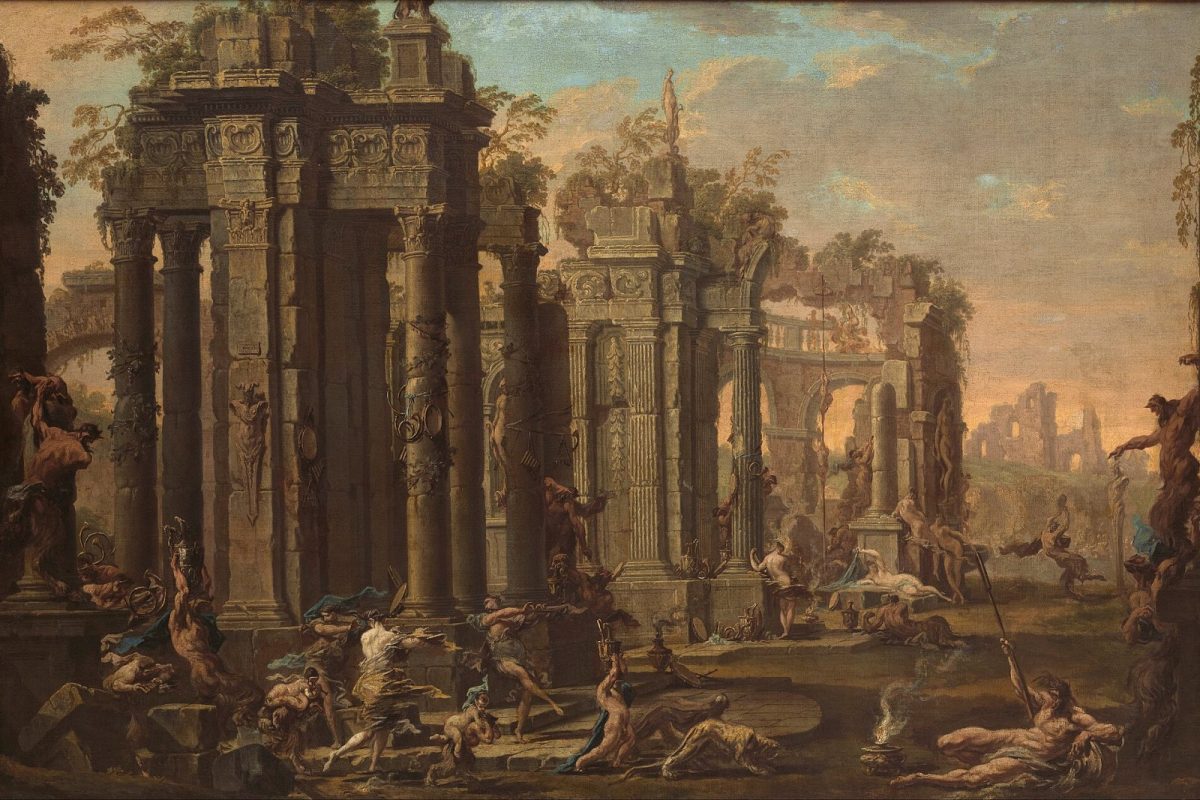
A God Made of Change
Let’s start with a simple idea: Dionysus was never just the patron of drunkenness. In the Greek imagination he was the god of transformation, the one who puts on disguises, crosses borders, and undoes the established order. He arrives from outside, throws things into disorder, and leaves. That condition of perpetual foreigner explains a good deal of what came afterward.
His mythical biography is as unstable as he is. In one version he is the son of Zeus and Persephone, torn apart and devoured by the Titans, then brought back to life. In another he is the son of Semele, who dies before giving birth, so Zeus sews the fetus into his thigh to finish its gestation. A third tradition presents him as turned into a kid goat by Hermes and as the inventor of wine. A traveler through Egypt and India before returning to Greece, Dionysus always appears as a mutable, ambiguous, borderline figure. It is no accident that such a god ended up associated with rites that also defied social limits.
From the Greek Chorus to the Grape Harvest
In the first festivals in his honor—tied to plant life and the grape harvest—choruses sang passionate hymns and, to resemble the billy goat of the divine retinue, their members dressed up as satyrs with goat legs. This is slippery ground for the historian: of those archaic liturgies hardly any precise traces remain, and much of what is told comes from later reconstructions. It is worth remembering that before taking the more lurid details as certain.
Rome and Its Tense Relationship With Wine
Rome loved wine but administered it with distrust. An ancestral custom excluded those under thirty and women from drinking, and the sources preserve brutal anecdotes about its enforcement: a husband who kills his wife for drinking from a cask and is acquitted, or a young woman condemned by her family to starve to death for going near the keys to the wine cellar. Whether true or merely cautionary, these stories say a lot about the nerve the subject touched: wine was not a neutral pleasure but a matter of hierarchy and gender.
Against that backdrop, the Bacchic cult was especially unsettling. What frightened people was less the intoxication than the image of women in a state of ecstasy, outside domestic control. For the Roman patriarchal order, this was not a religious eccentricity: it was a risk to social order.
How the Rite Became Popular
After the Second Punic War, the associations that worshipped the Roman Bacchus—the Dionysus of Thracian origin, with roots in the lower strata of fourth-century BC Athens—spread quickly through the city. Their devotees were mostly women, free and sometimes noble, along with well-off plebeians. For a comic playwright like Plautus, the Bacchanalia were already a byword for disorder and revelry.
At first the cult aroused little interest. That changed when, according to tradition, a priestess named Paculla Annia brought in young men, moved the ceremonies to the night, and multiplied their frequency, going from three days a year to five meetings a month. Some have read it as a kind of generational crisis. For many women and for the disadvantaged, the gatherings worked as an escape valve from a society that offered them few outlets: a religious answer to very earthly problems.
What Happened at a Bacchanal, According to the Sources
The scheme combined two elements: an initiation that brought the follower into the association and an ecstatic experience. Through wine, dance, and the erotic component, the initiate believed himself or herself “possessed” by the god. In that state, tradition says, women ran to the Tiber and men prophesied. Ancient accounts add scenes of sexual abandon between people of the same and of different sexes, something that scandalized the Roman morality of the day.
A methodological warning is due here. Nearly everything we know about the excesses of the Bacchanalia comes from hostile sources—consular speeches and historians who justified the repression. That is, from the prosecution’s file, not from the accused. These descriptions should be read as propaganda as much as chronicle: the genre of scandalous rumor has always been an effective political weapon.
The Crackdown of 186 BC
In 186 BC, the consuls Spurius Postumius and Quintus Marcius “discovered” that orgiastic nighttime mysteries were being held in the city. The institutional response came in the form of a decree, the Senatusconsultum de Bacchanalibus, one of the oldest surviving Roman epigraphic documents. It banned the rites and punished those who took part in them with death.
The official account mixed religion, wine, and crime in a single package. A famous passage sums it up:
“To the religious element were added the delights of wine and feasting, to draw in the minds of a greater number. When wine had inflamed their minds, and night and the mingling of men and women […] had destroyed all feeling of modesty, all sorts of corruption began to be practiced. […] Amid the howling and the crashing of drums and cymbals, the cries of the victims could not be heard.”
Followers were even accused of secret murders. Informers were rewarded, hiding fugitives was forbidden, and the sanctuaries were destroyed. The figures given by ancient sources are very high—on the order of several thousand condemned and executed—and, like any ancient figure, they should be taken with caution; even scaled down, they describe a state operation of enormous violence. Six years later, in 180 BC, a praetor was still complaining that the prosecution had not come to an end.
A Persecution That Was Not Aimed at Wine
The revealing detail is that Rome banned neither wine nor sex. It banned a group. The authorities presented the cult as a dangerous foreign superstition, but foreign rites and Eastern officiants also characterized another religion well established in the city, that of the Great Mother (Cybele). Between the lines, the consular speech itself lets us see what was really at stake: settling of scores, fear of autonomous associations, and the dread of revolt in a Rome that a few decades later would slide into civil wars.
The Bacchanalia, in fact, were apolitical: an autonomous religious movement, with an oath of silence, recognition signals among initiates, and strong internal solidarity. But that very autonomy—a network the state did not control—was enough to make them suspect. The charge of immorality was the wrapping; the real problem was the parallel power.
The ban, moreover, was not permanent. Once the “legal epidemic” had passed, the rejection faded. By the first century BC, the Roman triad of Ceres, Liber, and Libera had been assimilated to Demeter, Bacchus, and Proserpina, and the cult of wine flourished as never before, now among upper classes obsessed with immortality and grand sarcophagi. The same cult that had been hunted down with fire and sword ended up respectable once it stopped causing discomfort.
A Critical Reading
This story rests on sources that should not be mistaken for a neutral report. The central testimony is the speech Livy puts in the mouth of the consul Postumius, written more than a century later and with a clearly moralizing intent; to it is added the inscription of the senatorial decree, which regulates prohibitions but does not narrate what went on inside. The figures for the executed, the sexual details, and the “murders without corpses” belong to the register of denunciation, not of proof.
As a case study, the Bacchanalia remain useful for a reason that goes beyond the ancient anecdote: they show a pattern that repeats throughout the history of substances and altered states of consciousness. When a collective practice combines an alteration of consciousness, autonomy from those in power, and the participation of subordinate groups—women, the young, the poor—the institutional reaction tends to arrive wrapped in moral language, even if its engine is social control. Recognizing that mechanism helps us read the panics of the past, and of the present, more coolly.
For those who want to dig deeper, the classic threads in Spanish run through Antonio Escohotado’s Historia general de las drogas (General History of Drugs), through the studies on the role of women in antiquity by Molas Font and Almirall (Vivir en femenino), and through J. M. Blázquez Martínez’s work on the edict on the Bacchanalia. They are worth comparing with one another: they do not always agree, in tone or in figures.


