

In brief
- A team from Bern and Basel pooled six trials involving 202 participants on psilocybin-assisted therapy for alcohol use disorder; three were double-blind randomized controlled trials.
- Compared with control groups, less drinking was observed in the short term; among continuous drinking measures, at mid- to long-term follow-up only the difference in the percentage of drinking days held.
- The authors describe the evidence as “mixed,” with preliminary signals. The October 20 editorial update incorporates methods, results and risk-of-bias assessment from the journal’s HTML version.
The authors describe psilocybin-assisted therapy as a promising intervention for alcohol use disorder. Yet according to the authors of a new paper, recent clinical evidence had not been systematically synthesized. A systematic review and meta-analysis published online on October 8 in the Journal of Psychopharmacology sets out to do that. Its conclusion is cautious: the evidence is “mixed,” although it suggests preliminary signals of efficacy.
What was analyzed
The paper is authored by Gianluca A. Florineth, Leila M. Soravia and colleagues from the University Hospital of Psychiatry and Psychotherapy at the University of Bern, the Department of Psychiatry (UPK) at the University of Basel, University Hospital Basel and the Südhang clinic in Switzerland. Two independent reviewers systematically identified recent clinical trials in PubMed, PsycINFO and Scopus. The team pooled the data using random-effects meta-analyses and examined two things: the before-and-after change within treated groups, and the difference compared with control groups in the randomized trials.
Six trials, with 202 participants in total, met the inclusion criteria; three were double-blind randomized controlled trials. Another open-label trial randomized participants between two conditions involving high-dose psilocybin; without a comparable control group, it was analyzed as a before-and-after cohort. The primary outcomes were continuous drinking measures and abstinence rates; adverse events were a secondary outcome.
The results
Within the treated groups, every drinking measure fell significantly, and the reduction held at follow-ups ranging from 4 to 28 weeks. Because this is a before-and-after comparison with no reference group, it cannot on its own attribute that improvement to the intervention.
That is what the comparison with controls in the randomized trials is for. In the short term, the authors describe moderate advantages for psilocybin: standardized mean differences (SMD) of 0.48 for drinks per day (p = 0.004), 0.50 for the percentage of drinking days (p = 0.009) and 0.39 for the percentage of heavy drinking days (p = 0.020). At mid- to long-term follow-up, only the percentage of drinking days remained significantly better (SMD 0.41; p = 0.032).
The SMD is a standardized effect size and has no physical units. A value of 0.48 for drinks per day does not mean 0.48 fewer drinks, and the figures for the outcomes expressed as percentages are not percentage points.
Participants who received psilocybin had significantly higher odds of maintaining abstinence than controls at 4–28 weeks of follow-up (odds ratio 2.78; 95% confidence interval: 1.11–6.97; p = 0.029). In the short term, the difference in abstinence was not statistically significant (OR 1.80; p = 0.309). A group’s odds compare the probability of staying abstinent with the probability of not doing so, and the odds ratio compares those odds between the two groups. The value favors psilocybin, but it does not mean the probability of abstinence is multiplied by 2.78. These relative figures alone do not show how many additional people achieved abstinence. Its definition varied across trials, from no alcohol use to allowing one unit per day. According to the authors, adverse events were mostly mild and transient.
What this means
The authors interpret the data as preliminary signals that this therapy may reduce alcohol consumption and increase the odds of maintaining long-term abstinence, and they consider it well tolerated. The evidence base remains limited: six trials, three of them double-blind randomized controlled trials, and 202 participants. Reviewing the journal text clarifies a central limitation: all six trials were rated at high risk of bias. Problems included blinding in controlled trials, and confounding and outcome assessment in non-randomized studies. This reduces confidence in the size of the effects. What was evaluated is psilocybin-assisted therapy within clinical trials, not the substance on its own.
For background on the substance, our guide to psilocybin and magic mushrooms offers general context. In the addiction field, another recent meta-analysis on ketamine found fewer relapses only during the first month after treatment.
Editorial correction and update · October 20, 2026: we corrected the subscription-only description and added the abstinence follow-up period, uncertainty and methodological limitations. The original publication date is retained.
Sources
- Florineth GA, Boeker AL, Bracht T, Wopfner A, Denier N, Adorjan K, Müller F, Soravia LM. Efficacy and safety of psilocybin-assisted therapy for alcohol use disorder: A systematic review and meta-analysis. Journal of Psychopharmacology, published online October 8, 2026 (DOI 10.1177/02698811261490221; PMID 42850948). The journal provides an open-access HTML version.
- Bibliographic record and abstract on Europe PMC, accessed October 19, 2026. This was the source for the initial October 19 version. The October 20 update also consulted methods, results and risk-of-bias assessment in the journal’s HTML version. The PDF and supplements have not been reviewed.
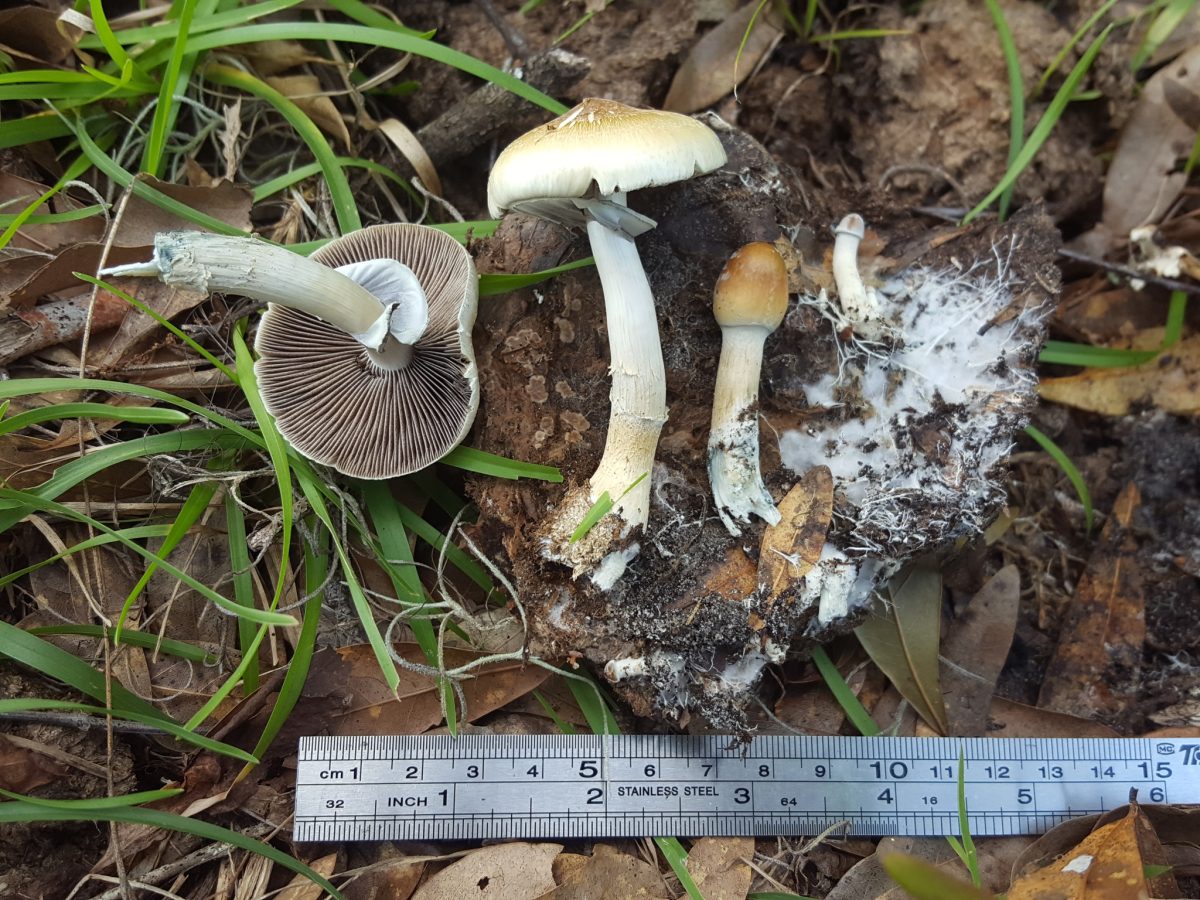
Psilocybe cubensis mushrooms; illustrative image not taken from the study. Photo: Alex Abair / Wikimedia Commons (CC BY 4.0).
Educational content written from a harm reduction perspective and with respect for individual freedom. It is not a substitute for advice from a healthcare professional and is not intended to encourage or condemn any drug use.