

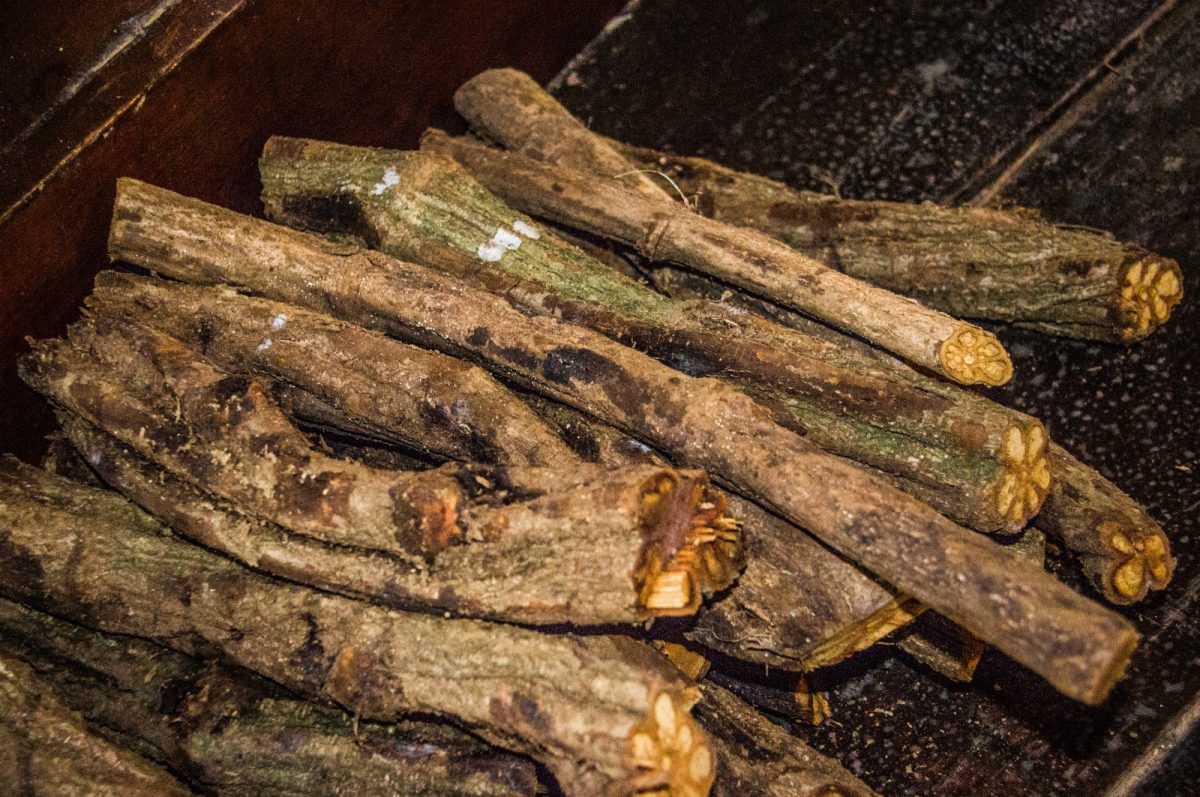
A Three-Decade Curiosity
There are substances one tries on impulse and others one pursues for half a lifetime. For Eduardo Hidalgo, ayahuasca always belonged to the latter category. His curiosity went back a long way: to childhood, to readings about jungles, tribes, and worlds that were then labeled as “the ethnic.” From a schoolbook in Italian, I fiumi scendevano a oriente, read in one sitting during his adolescence, he remembers not so much the anecdotes about Jivaro people and anacondas, but a detail that stuck with him: the mention of the “vine of the dead.”
It was 1982, the years of heroin addiction and social panic regarding drugs. And yet, what that teenager took away was a promise: sooner or later, he would try it. It took him about thirty years to fulfill it. Along the way, as he himself acknowledges, he went through more than fifty psychoactive substances. Ayahuasca simply wasn’t at hand; for decades, it was nowhere near the most accessible item on the market.
Neoshamanism and Its Mirages
Between trying other things, Hidalgo also read. He cites a specific title, Shabono, by Florinda Donner, which recounted an alleged life among the Yanomami. The relevant detail—and the reason the book serves as a warning today—is that this Amazonian stay never happened as it was told: at the time, the author was preparing her doctoral thesis in anthropology in Los Angeles. Donner was part of Carlos Castaneda’s circle, another name associated with “ethnographic” accounts that later criticism dismantled as fiction.
This episode is not a footnote. A good portion of the popular psychedelic imaginary was built on testimonies that mixed experience, literature, and fabrication. Recognizing this does not diminish the value of real experiences; it helps to avoid confusing catalog mysticism with ethnography, or the power of an experience with the veracity of the person telling it.
From Cursed Drug to “The Medicine”
By the time Hidalgo decided to proceed, well into the new century, the context had changed completely. Ayahuasca had gone from a rarity to a phenomenon: “power plant,” “master plant,” “medicine.” Hidalgo observes this semantic shift with sarcasm. He is struck by the discourse that presents it as a universal remedy—anxiolytic, antidepressant, anti-addictive, all at once—that register in which it is no longer “a medicine that is also a drug, but a drug that is not a drug, but a medicine.”
The irony points to something real. When a substance is sold as a solution for any ailment, it is wise to be wary of both the enthusiasm and the label. Ayahuasca is being researched with interest in clinical contexts, but the marketing of retreats and “healings” often runs far ahead of the evidence. That something has therapeutic potential does not make it harmless or suitable for everyone.
A Tailor-Made (and Counter-Current) Plan
The most striking thing about this first installment is how he decides to approach it. Several experts on the subject advised him against taking it: he was going through a rough patch, and fragile states of mind do not pair well with psychedelics. They weren’t wrong. Even so, he moved forward with the company of a friend, J. C., who prepared a session tailored to him, dispensing with almost everything that tradition considers indispensable.
No purges, because the nausea and diarrhea worried him more than any “bad trip,” and because he suspects their original function has more to do with antiparasitic cleansing in the jungle than with the release of “negative energies.” No prior diet. No shaman, whose mere presence, he says, would ruin the experience for him. And no icaros, the songs that many consider as important as the drink itself. A full declaration of principles against the ritual wrapping, made from a confessed ignorance of the subject matter.
There is one line, however, that he draws firmly: no sex surrounding the experience. And here his humor turns serious. He cites Jacques Mabit, founder of Takiwasi—a rehabilitation and research center for traditional medicine in the Peruvian Amazon—regarding the seduction techniques that some “sorcerers” employ: songs and perfumes that act subliminally to generate sensations of peace and ecstasy that the person attributes to the guide, until the guide “subjugates them and convinces them that they have to sleep with him and give him money.” It is the dark side of the phenomenon, the one that rarely appears in the brochures.
Critical Reading
Hidalgo’s chronicle acts as an antidote against two extremes: beatific apology and moral panic. It is not a manual or a consumption guide, and it will not be one here either. But it leaves on the table issues that should be highlighted from a harm reduction perspective:
The starting state matters. The account itself admits he was going through a bad time, exactly what serious environments advise against. Psychedelics can amplify distress and, in people with psychiatric vulnerability or a history of psychosis, precipitate severe crises.
Ayahuasca contains MAO inhibitors. This creates potentially dangerous interactions with numerous medications—SSRI antidepressants among them—and certain foods. It is not a minor detail that the “medicinal” discourse tends to hide.
Abuse exists. Mabit’s warning is not anecdotal: the lack of regulation in many retreats coexists with documented cases of manipulation, sexual abuse, and economic extortion. Trust should not be assumed just because someone is dressed as a shaman.
Mysticism and veracity are not the same. The case of Florinda Donner reminds us that the most captivating story can simply be false. Good advice for approaching all literature in the genre.
The second installment will narrate what happened on the night of the session. In the meantime, this first part is valuable above all as an exercise in critical observation of the apparatus that surrounds the plant today.