

In brief
- In Spain, Salvia divinorum is not a controlled substance and does not appear on lists of narcotics or psychotropics. The only regulation that restricted its public sale (Order SCO/190/2004) was annulled by the courts in 2005, meaning there is currently no specific state regulation prohibiting its sale, possession, or cultivation.
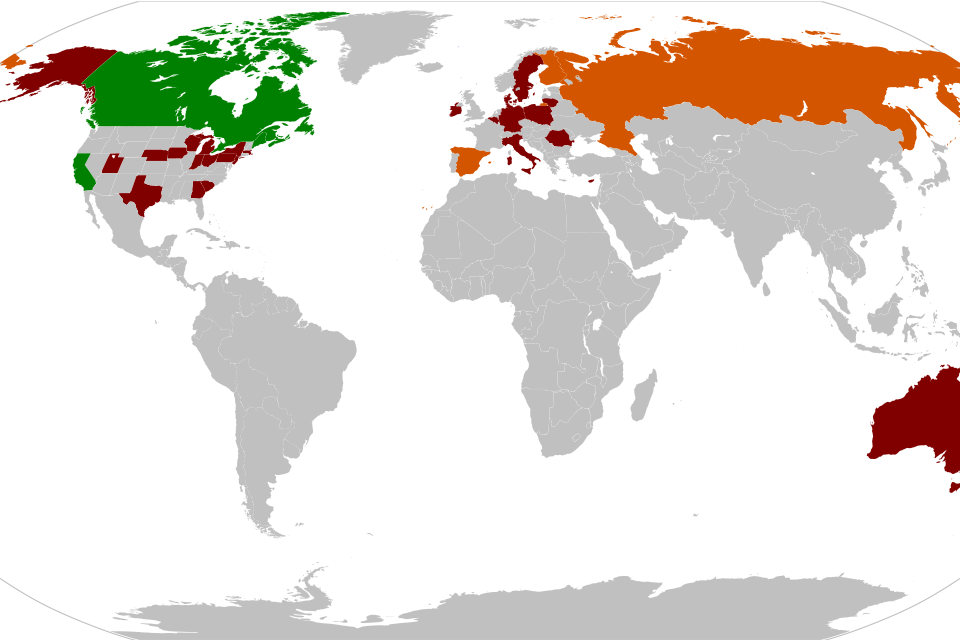
- The global map is highly fragmented: it is restricted in countries such as Australia, Italy, Germany, Japan, the United Kingdom, and Canada. In the United States, it is not a controlled substance at the federal level (regulated state by state), and in Mexico, it remains without specific restrictions.
- Its active principle, salvinorin A, acts on the kappa-opioid receptor, a target rarely seen among entheogens. Currently, it has no therapeutic use authorized by the EMA or the AEMPS.
Salvia divinorum is a plant in the mint family, native to the Sierra Mazateca (Oaxaca, Mexico), where it has been used for generations in ritual contexts by the Mazatec people. Its botanical, cultural, and pharmacological interest stems from salvinorin A, a compound of high potency and very brief effects. This article reviews the legal status in Spain and the rest of the world—information that is useful for making informed decisions.
What it is and why it sparks legal debate
Unlike classic hallucinogens (LSD, psilocybin), salvinorin A is not an alkaloid and does not act on serotonin 2A receptors: it is a terpenoid that functions as a selective kappa-opioid receptor agonist. This unique pharmacology largely explains why many legal systems have struggled to categorize it within their control lists, which were designed for other chemical families. Available research is still preliminary and mostly preclinical, sparking interest as a potential template for new drugs; for now, there is no authorized medical use.
Legal situation in Spain
In Spain, Salvia divinorum is not included in the lists of narcotic or psychotropic substances, so it is not a controlled drug. The only attempt to restrict its trade was Order SCO/190/2004, of January 28, which established a list of nearly two hundred plants whose sale to the public was prohibited or restricted due to their toxicity, including Salvia divinorum. However, that order was annulled by the National Court in 2005 (Contentious-Administrative Chamber), a ruling later ratified by the Supreme Court, so it never became established as current law.
The result is that, as of today, there is no specific state regulation in Spain prohibiting the sale, possession, or cultivation of Salvia divinorum: the plant exists in a legal vacuum. In practice, it is easily found online and in specialized shops, often under labels such as “sold for ornamental purposes” or “not for human consumption.” Its possession and private cultivation without commercial intent are not classified as a crime.
The legal map worldwide
The international landscape is heterogeneous. Australia was a pioneer in restricting it (2002) and places it in its strictest category. It was followed by, among others, Italy, Germany, Belgium, Denmark, Ireland, Japan, Poland, Sweden, and, more recently, the United Kingdom (under the Psychoactive Substances Act of 2016) and Canada (2023). In Japan, processed plant material is prohibited, but live plants are tolerated for ornamental purposes, an example of the many possible variations.
In the United States, Salvia divinorum and salvinorin A are not controlled by the federal Controlled Substances Act; the DEA classifies it as a “substance of concern,” and individual states legislate it, meaning its status ranges from total legality to being considered a serious crime depending on the territory. In Mexico, its country of origin, it is not subject to specific restrictions. The practical conclusion is simple: legality depends entirely on the jurisdiction and changes frequently, so it is advisable to verify any information against the current regulations of the specific location.
Harm reduction
If someone decides to approach Salvia divinorum, honest information is the best ally for self-care. Salvinorin A produces intense and often disorienting dissociative effects, with a temporary loss of contact with the environment. These effects usually last only a few minutes, but during that time, it is very helpful to be in a quiet and safe place, sitting or lying down, without driving or operating machinery, and ideally accompanied by a trusted person who remains sober and attentive (what many call a “sitter”) to prevent falls or injuries. Taking care of the set (state of mind and expectations) and the setting (the environment) makes a real difference in how the experience is lived. As scientific evidence remains experimental, effects vary significantly from person to person, and starting slowly allows one to gauge their own response. Legally, while it is not controlled in Spain and its sale is not specifically prohibited, possession can constitute a criminal offense in several countries—something to keep in mind, especially when traveling. And in the face of prolonged psychological distress, consumption that becomes problematic, or questions about potential interactions, seeking help from healthcare or drug addiction services is a sensible and judgment-free option.
Sources
- Ministry of Health and Consumer Affairs. Order SCO/190/2004, of January 28, establishing the list of plants whose sale to the public is prohibited or restricted due to their toxicity. BOE no. 32, February 6, 2004. Regulation annulled by 2005 National Court (Contentious-Administrative Chamber) ruling.
- Validity status of Order SCO/190/2004: “annulled by Ruling of the National Court (Contentious-Administrative Chamber, Section 4) of June 27, 2005.” Noticias Jurídicas.
- Cruz A, Domingos S, Gallardo E, Martinho A. Salvinorin A, a kappa-opioid receptor agonist hallucinogen: pharmacology and potential template for novel pharmacotherapeutic agents. Progress in Neuro-Psychopharmacology & Biological Psychiatry / PMC, 2017.
- Legal status of Salvia divinorum (compilation of international regulations with official references). Wikipedia, accessed in 2026.
Educational content written from a harm reduction perspective and with respect for individual freedom. It is not a substitute for advice from a healthcare professional and is not intended to encourage or condemn any drug use.


