

In brief
- Salvinorin A is the primary psychoactive compound in Salvia divinorum, a plant used for centuries by the Mazatec people of Oaxaca, Mexico, for divinatory and ritual purposes.
- It is considered the most potent natural psychedelic known: it is active in sub-milligram doses and acts as a selective agonist of the kappa opioid receptor, rather than the 5-HT2A serotonin receptor like LSD or psilocybin.
- Its effects are highly intense, very brief, and, in most reports, unpleasant. In Spain, its commercialization for human consumption has been regulated since 2004.
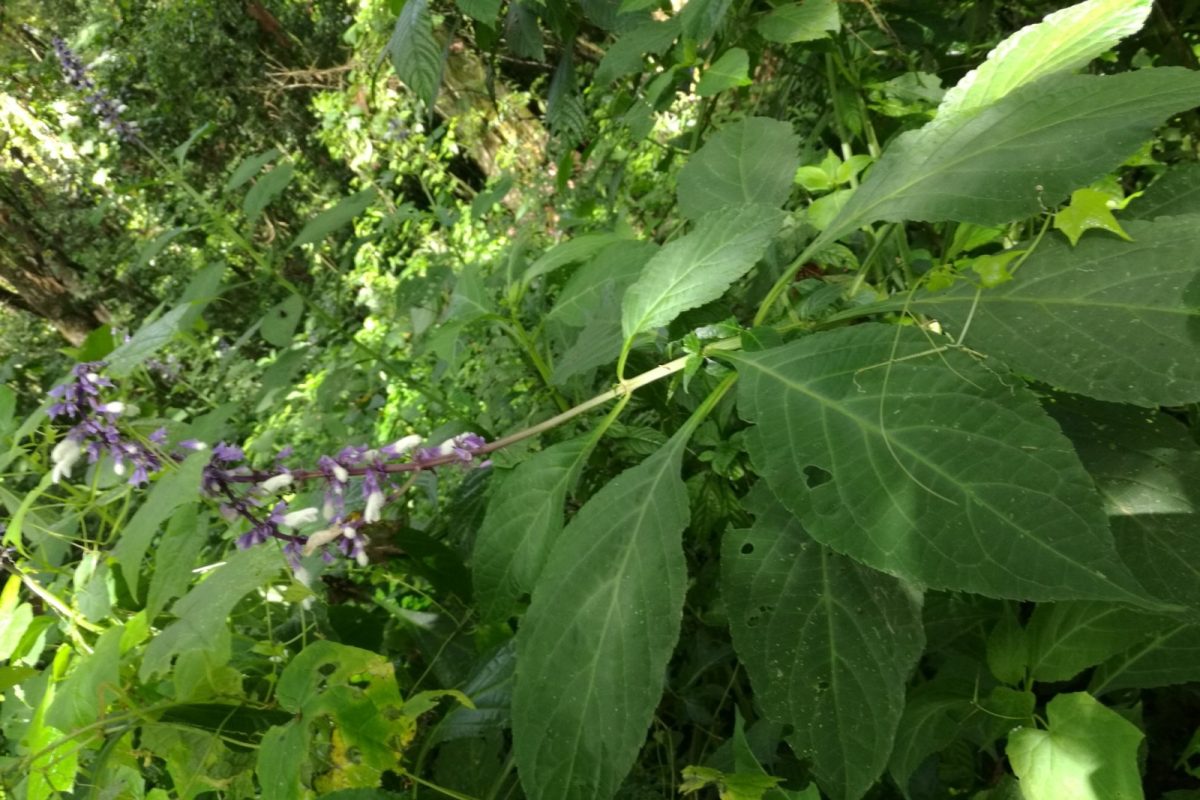
Salvia divinorum, known as “seer’s sage” or “ska María Pastora,” is a plant in the mint family native to the mountains of Oaxaca. Salvinorin A is isolated from its leaves, a molecule that has fascinated pharmacologists for two reasons: its extraordinary potency and a mechanism of action unlike any other classic psychedelic.
What is Salvinorin A
Chemically, salvinorin A is a diterpene—a plant-derived compound related to essential oils. Remarkably, it lacks a nitrogen atom, which is unusual among potent psychoactive substances; almost all molecules that act on the brain (opioids, alkaloids, psychedelics like mescaline or DMT) contain nitrogen in their structure. Salvinorin A was the first potent, naturally occurring opioid agonist described without that atom, a finding published by Bryan Roth’s team in PNAS in 2002.
This uniqueness translates into remarkable potency. While other natural psychedelics require doses in the tens or hundreds of milligrams, salvinorin A produces effects with quantities in the sub-milligram range (hundreds of micrograms) when vaporized or smoked. This is why it is often described as the most potent natural psychedelic known. It is important to clarify that “potent” does not mean “pleasantly intense”: it refers to the amount required to be active, not the quality of the experience, which most people describe as abrupt.
A unique mechanism: the kappa receptor, not serotonin
This is the major difference from other psychedelics. LSD, psilocybin, and mescaline owe much of their effects to the activation of the 5-HT2A serotonin receptor. Salvinorin A, however, barely touches that system. Its target is the kappa opioid receptor (KOR), for which it is a selective and highly effective agonist, with little activity on the mu or delta opioid receptors (which activate morphine or heroin).
The kappa receptor is part of the body’s own opioid system, but its role is peculiar. When activated intensely, it tends to reduce the availability of dopamine in brain regions related to reward. In animal models, this translates into aversion and a state similar to anhedonia, the exact opposite of what substances with high addictive potential do. This is the neurochemical reason why salvinorin A is rarely pleasant and why it is attributed a low potential for abuse: the very mechanism that makes it psychoactive tends to generate discomfort rather than compulsive seeking.
Effects, duration, and research interest
When vaporized, salvinorin A acts extremely quickly—the effect can peak in about two minutes—and fades soon after, typically within a few minutes to half an hour. During this time, those who have studied it describe markedly dissociative experiences: loss of the sense of one’s own body, spatial and temporal disorientation, a feeling of merging with surrounding objects, and an abrupt disconnection from ordinary reality. It is common for the experience to be confusing, with little capacity for voluntary introspection while it lasts; it is worth knowing this in advance so as not to mistake its brevity for gentleness.
This highly specific mechanism explains the scientific interest. The kappa opioid system is involved in the regulation of mood, stress, pain, and addictive behaviors, which is why researchers like Butelman and Kreek have proposed salvinorin A as a template for designing analogs—with partial or “biased” activity—that could be explored for depression, addiction, or pain without causing dissociative effects. It is important to keep this in perspective: this is preclinical and experimental research. Currently, there is no medication derived from salvinorin A, and its potential therapeutic utility has yet to be proven in humans.
Harm reduction
The intensity and abruptness of salvinorin A make it a substance that requires context and preparation. Its most immediate risk is not toxic, but behavioral: during the minutes of peak effect, one loses awareness of the surroundings and motor control, which can lead to falls or injuries. Therefore, if someone decides to explore it, they should be mindful of the space: it is best to be seated or lying down, away from stairs, windows, fire, water, or traffic, and never combined with driving or operating machinery. Having a sober person present to accompany and protect the space is the most effective precaution in the contexts where it has been studied, just as it was in traditional ritual use.
Psychologically, the experience can be very destabilizing and may trigger anxiety or distressing memories, especially in those with a history of psychiatric conditions or psychosis, for whom it is usually wiser to avoid it. Starting with very low doses, not mixing it with alcohol or other depressants, and reserving it for a calm moment—good set and setting—helps ensure that if the experience becomes difficult, it can be navigated with more support. And if at any point persistent discomfort or concerning usage patterns arise, seeking support from healthcare professionals or specialized drug services is a decision of self-care, not a failure.
Sources
- Butelman ER, Kreek MJ. Salvinorin A, a kappa-opioid receptor agonist hallucinogen: pharmacology and potential template for novel pharmacotherapeutic agents in neuropsychiatric disorders. Frontiers in Pharmacology, 2015.
- Roth BL, et al. Salvinorin A: a potent naturally occurring nonnitrogenous kappa opioid selective agonist. PNAS, 99(18):11934–11939, 2002.
- ICEERS. Salvia divinorum: basic information. ICEERS, accessed in 2026.
Educational content written from a harm reduction perspective and with respect for individual freedom. It is not a substitute for advice from a healthcare professional and is not intended to encourage or condemn any drug use.


