

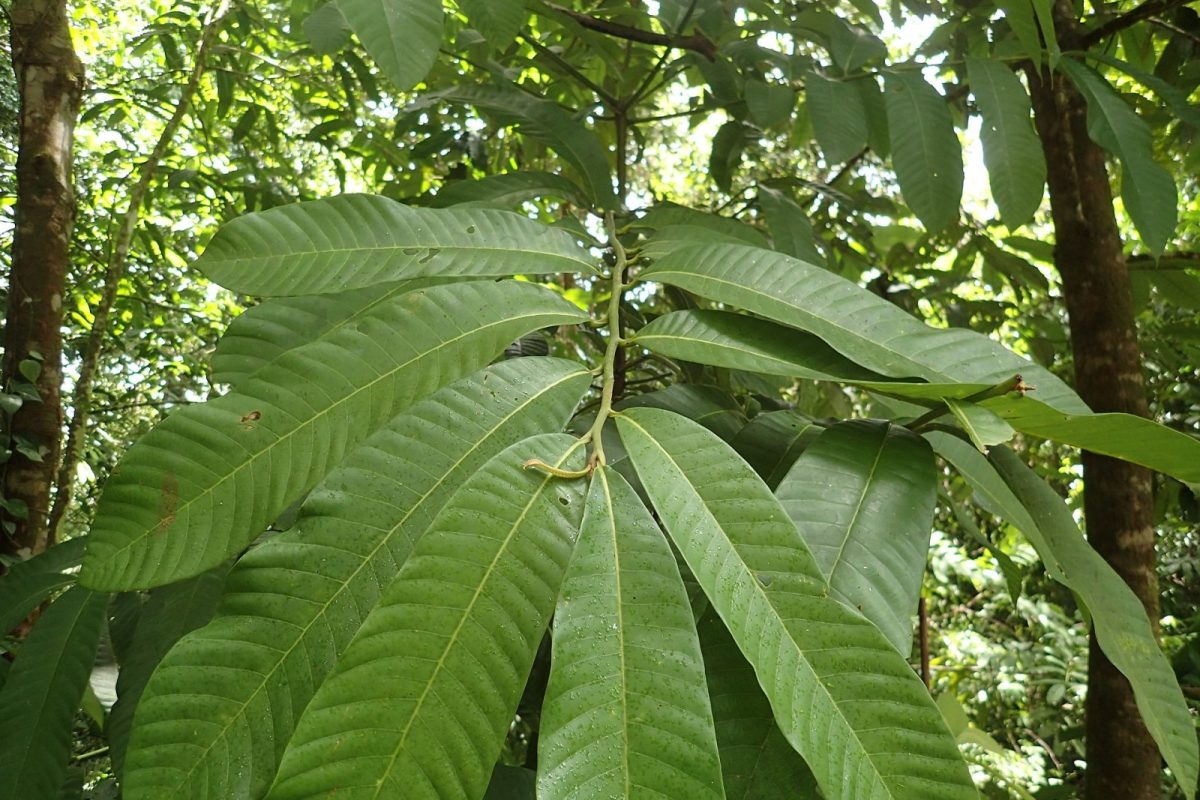
One Tree, One Resin, Two Tryptamines
The name Virola covers several species of jungle trees spread from Central America to the southern Amazon basin. What made them famous in the ethnobotanical literature is neither their wood nor their pungent-scented flowers, but a reddish resin lodged in the inner bark. That resin concentrates alkaloids of the tryptamine group, above all dimethyltryptamine (DMT) and 5-methoxy-dimethyltryptamine (5-MeO-DMT).
The two molecules shouldn’t be confused. DMT is the classic tryptamine of intense visionary states, associated with ayahuasca and a brief but imagery-laden experience. 5-MeO-DMT works differently: people who have described it talk less about “visual movies” and more about an emotionally overwhelming state, with a sense of suspended time and dissolution of the self. Researcher Jonathan Ott summed up the difference by saying that 5-MeO-DMT is like DMT without the visual plot. Other accounts describe it in far less friendly terms: in the 1970s some authors considered it of little interest, and some have compared it to having a crushing weight on the head.
From Yekwana Snuff to Western Science
The ritual use of Virola was documented systematically in 1954 by the American ethnobotanist Richard Evans Schultes, one of the central figures in the study of Amazonian entheogens. He was struck that such a widespread magico-religious ritual had gone unnoticed by earlier Western observers. The first known mention, much vaguer, dates from the early twentieth century, when a German ethnologist described the Yekwana of the upper Orinoco inhaling a snuff made from the resin of a tree.
Virola species go by many local names—epená, nyakwana, paricá, cumala colorada—and have been used among peoples of Brazil, Colombia, Venezuela, and Peru. In some communities in eastern Colombia the resin has had a wide ritual role: diagnosing and treating illness, divination, and magico-religious purposes. It is important to stress that this use is embedded in cultural and ceremonial contexts, and in accumulated knowledge, that cannot simply be transferred to other settings.
Variable Chemistry and Many Species
If anything defines Virola from a chemical standpoint, it is its enormous variability. The concentration and proportion of tryptamines change with the species, the part of the tree, and even the individual specimen. In the dried bark of some species DMT has been described as practically the only alkaloid; in others, such as the much-cited Virola theiodora, a mixture of tryptamines appears, with both DMT and 5-MeO-DMT present, and especially high 5-MeO-DMT contents have been reported in the resin.
The presence of tryptamines has been documented in more than a dozen species of the genus—among them V. calophylla, V. elongata, V. rufula, V. sebifera, and V. theiodora—although telling them apart is complicated and some authors suspect that certain “names” actually correspond to the same species. All this variability is precisely why the standard reference compilations (such as those by Ott, Rätsch, the Shulgins, or Trout) insist that more reliable analyses are needed before generalizing.
The “Light Toad” and the Confusion of Sources
5-MeO-DMT does not come only from plants. In North America it became popular through the secretion of the toad Bufo alvarius (now Incilius alvarius), whose venom contains the molecule in notable amounts. Around it even grew a nearly cult-like phenomenon. Beyond the anecdote, two things are worth keeping in mind: different natural sources can contain very different mixtures of alkaloids, and harvesting the venom of an amphibian also raises conservation problems for the species.
A Legal Status That Has Changed
For a long time it was repeated as a curiosity that 5-MeO-DMT was less controlled than DMT despite being more potent, an asymmetry explained mostly by DMT’s greater media fame since the 1960s. That picture is outdated: over the past two decades many countries have added 5-MeO-DMT to their lists of controlled substances. Legal status varies widely by jurisdiction and over time, so any categorical statement about its legality should be taken with caution and checked against the current rules where you are.
A Tree That Won’t Be Cultivated
Unlike other psychoactive plants that have entered the ethnobotanical circuit, Virola has resisted cultivation. According to ethnobotanists who have sought it in the field, it has not been domesticated even though it produces seeds, and in the Amazon itself the peoples who use it rely on wild harvesting. Nor has trade in it as a seed or garden plant become normalized.
A Critical Reading and Harm Reduction
A good part of what circulates about Virola comes from testimonies and popular literature, not clinical studies. This calls for several cautions:
- Extreme variability: two barks that look identical can have very different chemical profiles. Unpredictability is the rule, not the exception.
- 5-MeO-DMT is not “mild DMT”: it is a different substance, described by many as hard to manage and with an intense emotional component. Adverse experiences are not rare.
- Interactions: combining tryptamines with MAO inhibitors (such as the harmine found in Peganum harmala or in ayahuasca) radically changes the body’s response and multiplies the risks, including dangerous interactions with drugs—especially antidepressants—and with other drugs.
- Context matters: traditional use comes with a ritual framework, knowledge of the plant, and accompaniment. Isolating the molecule from its context doesn’t make it safer.
This article is educational and historical. It offers no instructions for preparation, dosing, or use, and does not encourage them. If the subject interests you, the sensible course is to learn about it thoroughly from serious sources and, at any physical or psychological discomfort, to put health and professional care first.
Sources Mentioned in the Literature
What is widely known about Virola rests on reference works in psychoactive ethnobotany, cited here by name only: Plants of the Gods (Schultes, Hofmann, and Rätsch), Pharmacotheon and Ayahuasca Analogues (Jonathan Ott), TIHKAL (Alexander and Ann Shulgin), The Encyclopedia of Psychoactive Plants (Christian Rätsch), and Some Simple Tryptamines (Keeper Trout). They are useful reading for anyone who wants to go deeper into the botanical, chemical, and historical context.