

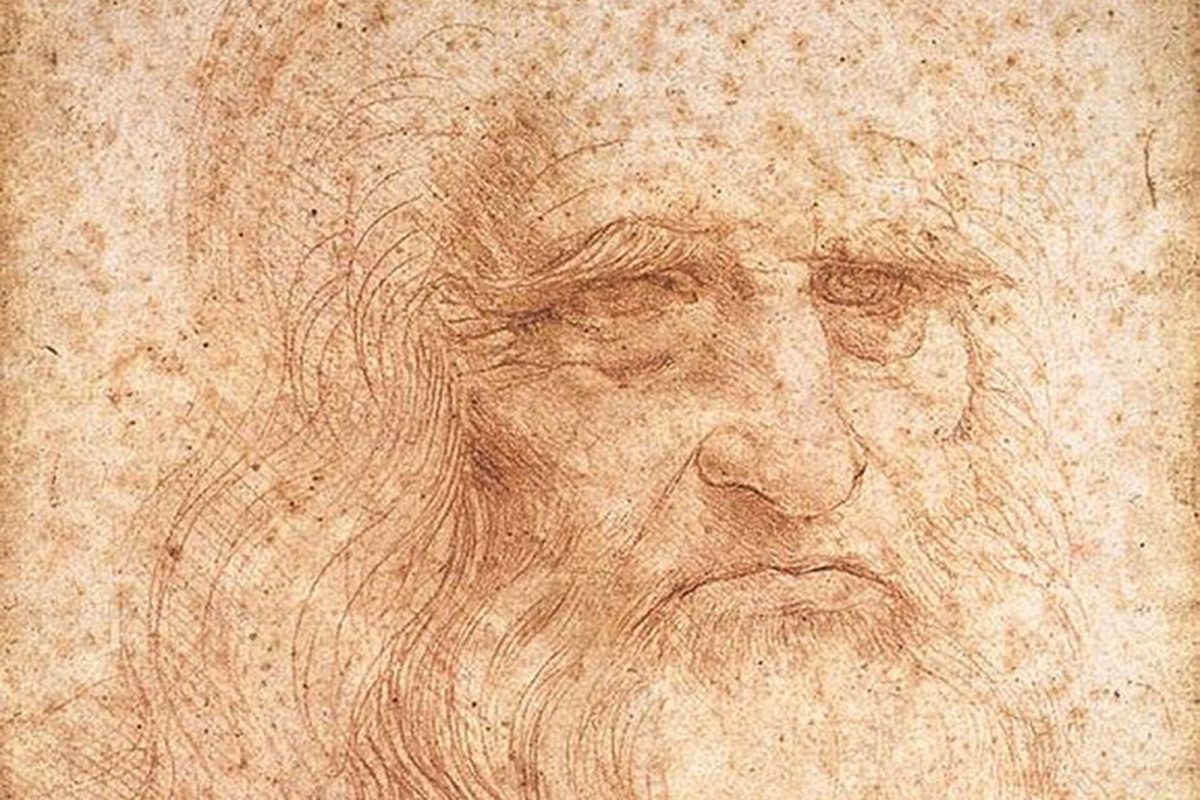
A genius turned legend magnet
Few figures attract as many stories as Leonardo da Vinci. Born in 1452 in the Tuscan town of Vinci, the illegitimate son of a Florentine notary and a peasant woman named Caterina, he trained in Verrocchio’s workshop and eventually embodied the ideal of the “Renaissance man”: painter, engineer, anatomist, and insatiable observer of nature. He worked for Ludovico Sforza in Milan, for Florence, for the papacy in Rome, and, at the end of his life, for Francis I of France, in whose circle he died in 1519 near Amboise.
That biography, partly documented and partly blurred, has served as fertile ground for all kinds of attributions. His mirror writing—legible only with a mirror—his vegetarianism (he called omnivores “corpse-eaters” and would release birds he bought in markets), and his little-known private life fuel a persona onto which it is easy to project any secret hobby, including hemp.
The Guild of Apothecaries: A plausible context
Leonardo belonged to the Guild of Doctors, Apothecaries, and Mercers. Italian speziali—the origin of the name for many historic pharmacies, the spezierie—traded in herbs, spices, drugs, and remedies from all origins. Therefore, it is not implausible that he knew of hemp: it was a daily raw material of European trade, especially as fiber for ropes, fabrics, and caulking.
Added to this environment is the figure of Tommaso di Giovanni Masini, nicknamed Zoroastro, a friend and collaborator of Leonardo for decades. An alchemist skilled with metals, he kept, according to letters of the time, a laboratory full of furnaces, flasks, cinnabar, and strange materials. It is a suggestive setting to imagine shared experiments, but it is worth remembering that jumping from there to deliberate cannabis consumption is a leap that the sources do not allow us to make with certainty.
Military use: Fiber, not substance
Where hemp appears most solidly in Leonardo’s work is in his artillery designs. He is credited with a notable innovation compared to the solid bullets of the time: hollow projectiles filled with shrapnel and flammable materials, which were far more destructive than simple impact bullets. In his notes, he describes wrapping the charge with materials that would ignite upon reaching the target, including pressed hemp tow.
The famous “Greek fire”—an incendiary weapon associated with the Byzantine Empire—also relied on hemp, but again as a physical support: balls of tow soaked in resinous, flammable mixtures. And the so-called Ear of Dionysius, the system of hollow tubes for transmitting voices over a distance attributed to him at the Sforza court, would have used hemp for its value as a material, not for any psychoactive property.
The honest reading of these episodes is clear: in all of them, hemp functions as an industrial fiber. Calling it “cannabis” without qualification, as the most widespread version of this story does, mixes two very different things and sows a confusion that should be cleared up.
Hemp bread and the problematic Codex Romanoff
The culinary story comes from the Codex Romanoff, a supposed cookbook by Leonardo that inspired the popular book The Notes of Leonardo da Vinci. It allegedly contains a recipe for hemp bread made from boiled and peeled seeds, almonds, honey, and spices, arranged in layers and pressed.
Caution is required here. That “codex” and the resulting book are widely considered apocryphal: a literary and humorous recreation rather than an authenticated Renaissance document. Taking the recipe as historical proof that Leonardo cooked with hemp is, at the very least, risky. And even if we accept it, hemp seed is a food without significant psychoactive effect; we would not be looking at a “cannabis dish” in the sense usually implied today.
Critical reading
The “Leonardo and cannabis” story works very well as a viral anecdote, but it rests on three slips that should be noted. First, the equivalence between hemp (fiber and seed) and psychoactive cannabis, which is not automatic. Second, the use of a culinary source of highly disputed authenticity as if it were firm testimony. Third, the tendency to read Leonardo’s biography—vegetarian, secretive, friend of an alchemist—as confirmation of hobbies that the sources do not document.
None of this diminishes the interest of the subject. Hemp was, indeed, a key material of the Renaissance, present in war, navigation, and daily life. Recognizing it as such, without turning Leonardo into a consumer ahead of his time, is more faithful to what we know and, incidentally, more respectful of the plant’s complexity. Authors like Charles Nicholl, in his biography of Leonardo, offer a much more nuanced portrait of the man and his environment than the one suggested by the most widespread version of this story.


