

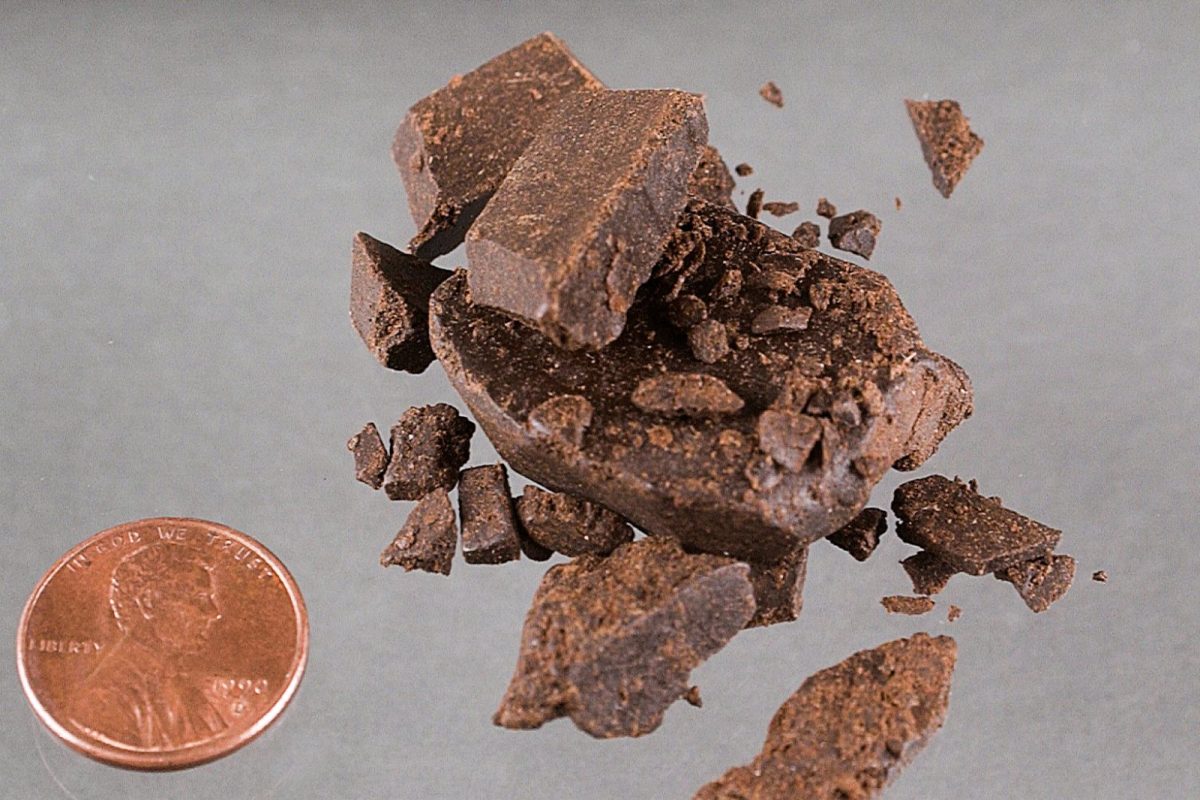
A more common dilemma than you might think
Among the inquiries that reach an archive like this, one domestic scene repeats itself: someone keeps hashish in a pocket, a backpack, or a garment, and it ends up wet due to carelessness, rain, or, quite literally, an unexpected laundry cycle. The usual reaction is to look for a way to “save it.” It is worth, first and foremost, separating two distinct things: recovering the dry appearance of the material and recovering something that is actually safe to consume. These two things do not always align.
What happens to hashish when it gets wet
Hashish is, in essence, a concentration of trichomes (the plant’s resin glands) pressed together with vegetable matter and, frequently in the black market, various adulterants. Water does not dissolve the resin, but it does affect everything else: it softens the mass, carries away particles, and, above all, creates a humid environment where fungi and bacteria proliferate easily. That is the real problem. It is not just a matter of aesthetics or flavor: damp material stored without drying can develop mold in a matter of days, and inhaled mold is a non-trivial respiratory risk, especially for people with asthma, allergies, or compromised immune systems.
Surface moisture versus soaked material
A piece slightly softened on the outside is not the same as a chunk soaked to the core. In the first case, the moisture is superficial and tends to evaporate on its own if left in a dry, ventilated place without aggressive heat sources. A common mistake is to accelerate the process with high heat: high temperatures “toast” the material, evaporate volatile compounds, and ruin both the aroma and the potency. Patience, in this case, beats haste.
When the piece is soaked, things change. The water has already penetrated, potentially carrying away some of the plant matter, and the pressed structure has broken down. Even if the material dries out, it does not return to its previous state: the texture, color, and, most likely, its contents have changed. At that point, the question stops being “how do I dry it” and becomes “is it worth the risk?”
The case where the answer is clear: throw it away
There is one scenario that allows for no nuance. If the hashish has gone through a washing machine, has been in contact with detergent, fabric softener, or bleach, or has been wetted with any cleaning product, the sensible thing to do is discard it. Not because of the waste of material, but because those products impregnate the mass, react with its components, and leave residues that would then be inhaled directly. No subsequent drying “cleans” that. Your health is worth much more than a few grams.
The same applies if, once dry, whitish or greenish spots appear, or if it smells of dampness, earth, or mold: these are signs of fungal contamination and sufficient reason not to consume it.
Critical reading and harm reduction
It is worth remembering the general framework. Black-market hashish has an uncertain composition: it is not known with certainty what adulterants it contains or in what proportion, and getting it wet only adds uncertainty about what happens chemically with that mixture. That is why this text does not provide “recovery recipes”: not because the procedure is a secret, but because the result is not verifiable and the boundary between “usable” and “dangerous” is difficult to judge by eye.
From a harm reduction perspective, the useful ideas are simple: inhaled mold is a real and not always visible danger; excessive heat degrades the material without making it safer; and any contact with cleaning products makes the doubt an easy decision—discard it. And, if smoking cannabis or hashish is part of your habits, it is worth keeping in mind that the inhaled route (combustion) carries its own respiratory risks, whether the material is wet or not.
In summary
Hashish that is slightly damp on the outside can usually be recovered by letting it dry slowly in a ventilated place. Soaked material rarely returns to what it was and requires monitoring for mold. And anything that has touched soap, bleach, or gone through a laundry cycle should be thrown away without a second thought. When faced with the choice between saving money or taking care of yourself, the educational answer is always the same: choose the latter.